Five-Toe Shoes for Yoga and Pilates: Studio Rules Come First
As an Amazon Associate I earn from qualifying purchases. How we test
Quick answer
Do not use five-toe shoes instead of studio-required grip socks. Treat shoes for the trip, footwear on a home mat, Reformer rules and toe socks as separate decisions. Ask your studio what it permits, and choose a grip-sock format within those rules before buying shoes for class.
Start with these options
Amazon product listing
ToeSox Bellarina Full-Toe Grip Socks
Covered individual toe sleeves
Trade-off: Not intended as an outdoor shoe
on Amazon →
Amazon product listing
Vibram Women's FiveFingers KSO EVO — Black/White, EU 38
Individual toe pockets
Trade-off: Every toe pocket must fit comfortably
on Amazon →
Check the selected size, color and seller before buying.
Key takeaways & how we assessed the options
In this article
Do not use five-toe shoes instead of studio-required grip socks. For yoga and Pilates shoppers, decide separately what to wear on the trip, on your own mat and in a booked class before buying a pair with five toe pockets.
We have not tested these shoes or socks for mat traction, machine compatibility or class comfort. This article uses manufacturer descriptions, the studio guidance identified below and practical buying distinctions; it does not rank products by measured grip or claim that toe separation improves your practice.
Assign each item a job before shopping
The confusion starts when “barefoot,” “toe socks” and “five-toe shoes” appear in the same search results. They describe different things. A thin rubber-soled shoe remains a shoe. A fabric sock with individual toe sleeves remains a sock, and its sleeves tell you nothing about whether it has grip material underneath.
A studio can require one format even if you prefer another. Buy around that requirement first, then decide whether you still want five-toe shoes for travel or permitted use elsewhere. Our beginner's guide to five-toe shoes explains the footwear format without treating a studio as a gym floor.
| Where you plan to use it | Start with this question | What to shop for |
|---|---|---|
| Walking to and from class | Do I want separate toe pockets for the journey? | Travel shoes that fit, plus separate class footwear |
| Yoga or Pilates on a home mat | Does my mat permit shoes, and do I want to wear them? | An allowed option suited to your own setup |
| Reformer or other machine class | What does this studio require for this session? | The specified socks or other explicitly permitted format |
| Studio requiring grip socks | Which toe coverage and sock style are allowed? | Grip socks, with or without individual toe sleeves |
| Toe socks inside shoes | Do the combined layers fit every pocket? | Low-bulk toe socks compatible with the shoe fit |
The trip to the studio is a shoe decision
Five-toe shoes can be a purchase for the walk to class without becoming class footwear. That separation is useful if you like individual toe pockets but attend a studio that asks you to remove outdoor shoes. Pack the required socks separately and change where the studio directs you.
Think about the journey you actually make: a short walk from transport, a longer pavement route or a trip involving wet weather. Do not choose solely because a product name appears beside yoga clothing. Check the maker's intended use and materials against that journey, and avoid inferring waterproofing or certified slip resistance from an outsole description.
For example, Vibram's current KSO EVO page describes a simple adjustable upper and positions the shoe for functional and strength-based workouts. That is a manufacturer description, not evidence that the shoe is waterproof, approved for your studio or tested on your mat.
If the trip is the only job, extra gym features may have little value to you. The KSO EVO and V-Train 2.0 comparison explains the different uppers and closures. There is no reason to buy a more complicated closure simply because your destination is a Pilates studio.
Keep outdoor shoes apart from the clean socks you intend to use in class. A separate bag compartment also makes the change easier: shoes come off, socks go on, and the purchasing decision stays clear. You do not need a second pair of shoes merely to cross from reception to the studio floor unless that studio asks for one.

On a mat at home, start with the mat
At home, studio admission rules drop out of the decision, but the mat still matters. Check its manufacturer's footwear and care instructions before using shoes on it. Permission to wear a shoe indoors does not establish compatibility with a particular mat's surface or warranty.
Then decide what problem the purchase is meant to solve. Wanting covered feet, preferring separate toes and wanting shoes for other activities are different reasons. If your only goal is coverage, investigate the allowed sock options before committing to a five-pocket shoe. If you already own shoes, you still need to check the mat rather than assuming a thin outsole is equivalent to bare feet.
We cannot tell you that KSO EVO, V-Train or another five-toe shoe will grip better than bare feet or grip socks on your mat. No comparison testing supports that conclusion here. Product language about balance or functional fitness is manufacturer positioning, not proof of better yoga or Pilates outcomes.
Consider the contact surfaces involved in your own practice without turning that into a training prescription. A pocket seam, closure or outsole edge may be something you want to inspect during a return-compliant indoor fitting. Do not keep a pair on the expectation that uncomfortable pressure must be necessary for adaptation. Pain and clinical questions call for individualized advice.
Reformer rules belong to the studio
Ask the studio about the exact session you booked before buying footwear for a Reformer class. “Pilates,” “Reformer” and other machine-based studio classes are not one universal footwear policy. A shoe allowed elsewhere in the building may still be excluded from its machines.
As a concrete example, solidcore's new-client guidance says shoes are not permitted on its machines. That is a rule for its setting, not evidence that every Pilates business uses identical rules. Do not extrapolate a sock requirement, a permitted toe style or an exception from another studio's website.
A useful message to reception is: “For my booked class, are grip socks required, are individual toe sleeves allowed, and is full toe coverage required?” If you want to wear any shoe on equipment, identify the model and ask explicitly. Bring the requested item even if you normally practise differently at home.
For a grip-sock purchase, use our Pilates and barre grip-sock guide after confirming the rule. Its product suggestions do not override local instructions. Also check any rules about changing out of outdoor footwear before entering the exercise room.
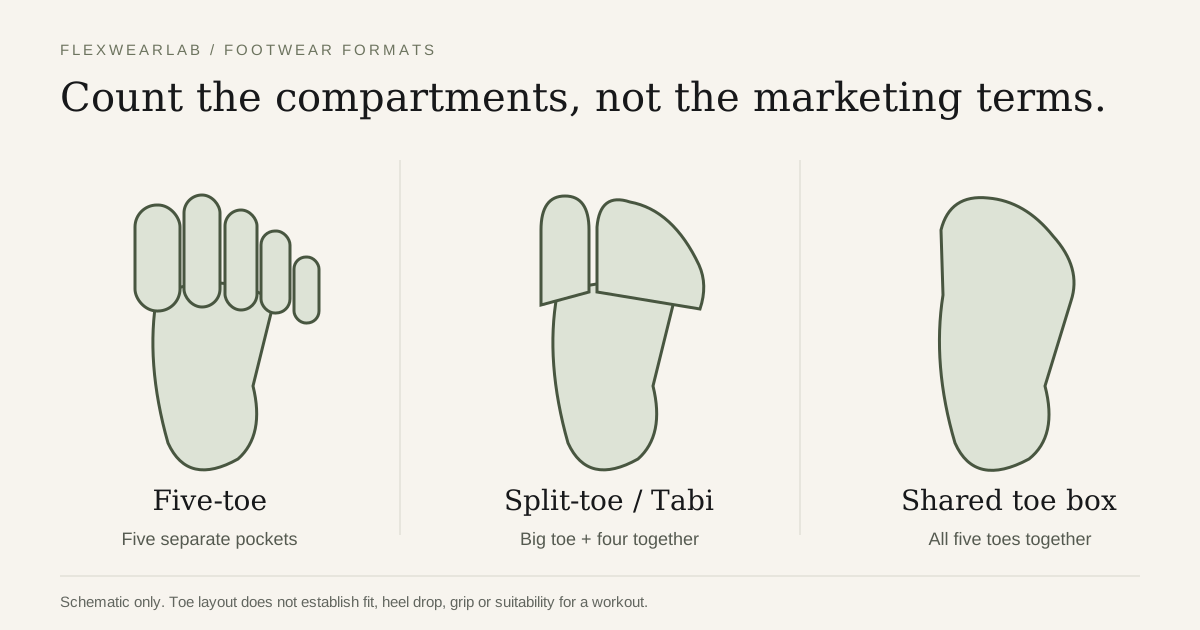
Toe socks, grip socks and toe shoes are separate categories
A five-toe sock has five fabric sleeves. A five-toe grip sock adds grip material to a sock in that format. A five-toe shoe has individual toe pockets within footwear. None of those descriptions establishes which item a studio accepts.
Injinji's Run Lightweight No-Show, for example, is a low-bulk toe sock described for running and walking. It is not a silicone-grip studio sock. Buying it to wear inside shoes does not also satisfy a class requirement for grip socks.
If you prefer separated toes in class, first check that the studio permits the specific coverage you want. Full-toe, half-toe and toeless are not interchangeable descriptions. Our grip-sock toe-style comparison explains those shapes; use it to narrow the format after checking the rule, not to assume an uncovered toe tip is allowed.
Fit the sock for the job it will actually do. A grip sock bought for class does not automatically belong inside a toe shoe, where bulk and the grip surface may change the fit. Likewise, a lightweight liner chosen for shoe pockets should not become your class sock just because it has individual sleeves.
Order the correct combination, not a bundle by default
For a studio visit, the sensible basket may contain grip socks alone. Add five-toe shoes only if you independently want them for the journey or another permitted activity. That keeps the shoe purchase from becoming an unnecessary admission expense.
If you do buy shoes, measure and use the chart for the actual model and men's or women's version. Vibram's FAQ says fit varies between models and comfort decides; toe geometry can still make a nominally correct size unsuitable. Our FiveFingers sizing and toe-sock guide covers that separate fitting task.
A KSO EVO Amazon search is a tagged search, not a verified product offer. Check the seller, precise model, sex-specific size chart and returns. Search results do not establish authorized-dealer status, authenticity or stock. No shoe listing can confirm your studio's permission for you.
Frequently Asked Questions
Can I leave my travel shoes on during a private lesson?
Only if the instructor and venue explicitly permit them for that lesson and equipment. A private booking does not itself create a footwear exception. Ask before arriving with shoes as your only option.
Should I buy half-toe grip socks if my shoe pockets feel tight?
Do not treat half-toe studio socks as a fix for an incorrectly fitting shoe. Choose class socks around studio requirements and personal fit, and assess shoe sizing separately. Cutting or changing coverage cannot guarantee that incompatible toe pockets will fit.
Are split-toe Tabi a substitute for five-toe studio shoes?
No. Split-toe Tabi separate the big toe from the other four, while five-toe shoes have five independent pockets. Fashion footwear in that shape does not acquire machine or mat approval from the toe design.
How should I pack shoes and socks after class?
Separate worn items from clean class socks and follow each product's care label before reuse. Vibram's general guidance is cold, gentle washing and air drying without a dryer; Injinji specifies cold delicate washing and line drying for the cited sock. Allow drying time instead of packing damp items indefinitely.
Products mentioned
Research shortlist, presented without ranking. Check the linked product details or current listings for available variants and sellers.
ToeSox Bellarina Full-Toe Grip Socks
Manufacturer information · not testedA separate studio option when grip socks are required: five covered toe sleeves rather than a shoe or an ordinary running toe sock. Check the selected size and the studio’s policy.
Pros
- + Covered individual toe sleeves
- + Grip sole for studio use
Cons
- - Not intended as an outdoor shoe
- - Toe lengths still need to match the sleeves
Vibram Women's FiveFingers KSO EVO — Black/White, EU 38
Manufacturer information · not testedA simple adjustable-upper option. This link selects women’s EU 38 / US 7.5–8 as an example, not a sizing recommendation. Select your measured size and confirm the seller; the checked offer was from third-party retailer Grivet Outdoors.
Pros
- + Individual toe pockets
- + Manufacturer positions this model for functional and strength workouts
Cons
- - Every toe pocket must fit comfortably
- - Seller, size availability and return terms can change
Still comparing? Search Amazon
Our storefront →Today's Deals →Quick searches, tagged so you support the site at no extra cost. See this month's deals page for the picks that are discounted right now.
Amazon prices and availability change often; check the listing for current details. As an Amazon Associate I earn from qualifying purchases.


