Five-Toe Shoes for Gym and Lifting: Choose by Your Workout
As an Amazon Associate I earn from qualifying purchases. How we test
Quick answer
Consider five-toe shoes for permitted gym work when you already want a thin, flexible shoe and each toe pocket fits. Compare V-Train 2.0 for mixed circuits and KSO EVO for a simpler upper, but choose treadmill and class footwear around the actual activity. Neither is a raised-heel lifting shoe, and gym approval comes first.
Start with these options
Amazon product listing
Vibram Men's FiveFingers V-Train 2.0 — Black/Black, EU 45
Separate lace and strap adjustments
Trade-off: Not protective lifting footwear
on Amazon →
Amazon product listing
Vibram Women's FiveFingers KSO EVO — Black/White, EU 38
Individual toe pockets
Trade-off: Every toe pocket must fit comfortably
on Amazon →
Check the selected size, color and seller before buying.
Key takeaways & how we assessed the options
In this article
Buy five-toe gym shoes only if your gym permits them and you specifically want a thin, flexible shoe with separate toe pockets. For lifters who also use treadmills, join circuits or attend fitness classes, the deciding question is which activity the purchase must actually cover.
We have not tested these shoes for lifting, traction, lateral support or treadmill comfort. Our recommendations interpret manufacturer specifications and the shopping situations below; they are not measured performance rankings. Start with the five-toe shoes beginner's guide if the format itself is unfamiliar.
Pick the activity before the model
A shoe that appeals at the weight rack may be an awkward purchase for a session mostly spent running or following a class instructor. Write down the activities you expect one pair to cover, including any equipment-specific footwear requirements. Then use the least compatible part of that list to decide whether one pair makes sense.
| Your main session | Shopping decision | Check before buying |
|---|---|---|
| Lifting with little else | Consider five-toe shoes if you want flexible footwear and the facility accepts it | Whether you actually want a raised heel or a different platform |
| Mixed strength circuits | Compare V-Train 2.0's construction with an ordinary cross-trainer | Sideways movement, jumping, ropes and the instructor's shoe rules |
| Treadmill walking or running | Shop for that treadmill activity first | Your preferred underfoot feel and the machine or facility requirements |
| Fitness classes | Ask for the class-specific footwear policy | Dance turns, lateral steps, floor contact or dedicated cycling shoes |
No row is a claim that five-toe shoes make an exercise better. The table is a way to avoid buying a specialist format for the smallest part of your visit.
Lifting: separate a low profile from a raised heel
Choose five-toe footwear for lifting because you want its construction, not because every lifting shoe serves the same purpose. A raised-heel lifter intentionally puts the heel above the forefoot. A thin flexible five-toe shoe should not be treated as a substitute for that geometry or for the structure of a dedicated lifting shoe.
If you already know you prefer a raised heel, buying toe pockets will not reproduce it. If your priority is minimal material around the foot, compare fit and closure instead of looking for promises about stronger feet, better posture or bigger lifts. We have no testing that supports those promises.
Also separate covering the toes from protecting them against dropped equipment. The models discussed here are not steel-toe or certified safety footwear. A rubber sole and fabric upper do not establish impact protection. Follow the facility's footwear policy and any rules for its lifting areas; do not assume the word “shoe” settles the question.
For a dedicated lifting purchase, ask yourself whether you want five separate pockets enough to accept the fitting process. A conventional shoe with a roomy toe box is a different format and may be simpler to shop for. Toe room alone does not make a shoe five-toe.

Mixed circuits: compare the upper, not just sole thickness
Vibram's V-Train 2.0 product page lists a 4 mm XS Trek rubber outsole, a 2 mm EVA footbed, lateral TPU panels, laces and a hook-and-loop closure. It also lists arch rope lugs. Those details make it the more relevant model to investigate when your shopping list includes mixed gym work.
They do not prove that it holds your foot securely during every sideways movement or that its grip suits your floor. Closure adjustment and the way the upper sits on your own foot still matter. Rope lugs are a design feature, not a reason to buy the shoe if ropes are absent from your sessions.
The current KSO EVO page describes a light, simple adjustable upper and positions it for functional and strength-based workouts. It no longer publishes the detailed rubber and insole measurements shown on older pages, so we do not use those older figures to calculate a stack height or rank it against V-Train. Compare the construction and fastening on the actual pair you order.
Read our KSO EVO and V-Train 2.0 comparison for the model details. For a first circuit class, the broader CrossFit clothing guide supplies outfit context; ask the actual coach about footwear rather than importing another class's expectations.
Treadmill use deserves its own decision
Do not buy a five-toe gym shoe on the assumption that a treadmill makes any thin shoe suitable for running. A treadmill segment can mean an easy walk between activities or the main reason you came to the gym. Those are different shopping priorities even though the machine is the same.
If running is the main purpose, compare shoes for that purpose and the underfoot feel you want. The gym-oriented construction details above cannot tell us how comfortable either shoe will feel to you on a belt. A manufacturer's functional-fitness positioning is not evidence of running suitability for every person.
For a mixed visit, carrying a second pair is a reasonable purchasing decision. It can be more useful than forcing one pair to satisfy conflicting preferences. This is not a recommendation for a running distance, pace or transition schedule. If pain or a clinical question is driving your footwear change, get individualized advice rather than using a shoe comparison as a training plan.
Fitness classes: identify the floor and the rules
“Fitness class” is too broad to be a shoe category. A dance-based session, a circuit class and an indoor cycling class may ask for different footwear. Confirm the named class, not merely whether the building lets members wear FiveFingers in the gym.
Ask whether the class includes turns, lateral steps, equipment contact or work on a mat, then ask what footwear the instructor permits. Do not infer that rubber which grips one surface will behave the way you want during a turn on another. We have not tested pivoting or traction on studio floors.
For classes requiring dedicated equipment-compatible shoes, follow that requirement. For classes requiring grip socks, five-toe shoes are not a substitute. Our studio-focused five-toe guide separates travel shoes, mats and machine rules in more detail.
Check policy and fit before committing
Send the gym the model name or product page and ask whether it meets the footwear rules for the areas you use. Some policies use terms such as athletic shoes or closed-toe footwear without explaining toe-pocket designs. A direct answer is more useful than interpreting those terms yourself. The gym etiquette guide covers the wider clothing context.
Vibram's KSO EVO page advises measuring both feet from heel to longest toe late in the day and using the longer measurement. Its FAQ also makes clear that models differ and comfort matters. A glove-like fit should not mean accepting pinching or a toe forced into the wrong pocket.
Check every toe, the heel and the closure while following the retailer's indoor try-on conditions. A correct overall length cannot fix incompatible toe geometry. Do not automatically size up to solve one tight pocket; reassess the model and chart. Plan any intended toe socks into that fit check, as explained in our sizing sibling linked from the beginner's guide.
Use search links as a starting point
You can compare Vibram V-Train 2.0 listings or KSO EVO listings, but these are tagged searches, not verified offers. Results may mix models, men's and women's listings, colors and sellers.
Check the exact model, the sex-specific size chart, seller identity and return terms before ordering. A specialty retailer's listing does not establish that it is an authorized dealer, and a search result does not guarantee authenticity or availability. Favor a clear listing and workable returns over a result that merely matches your search words.
Frequently Asked Questions
Can I wear ordinary socks inside five-toe shoes?
Ordinary socks do not provide five separate sleeves to align with the shoe's pockets. If you want socks, investigate thin toe socks and verify the combined fit. Do not assume the same size works equally well with and without them.
Are five-toe gym shoes the same as split-toe Tabi?
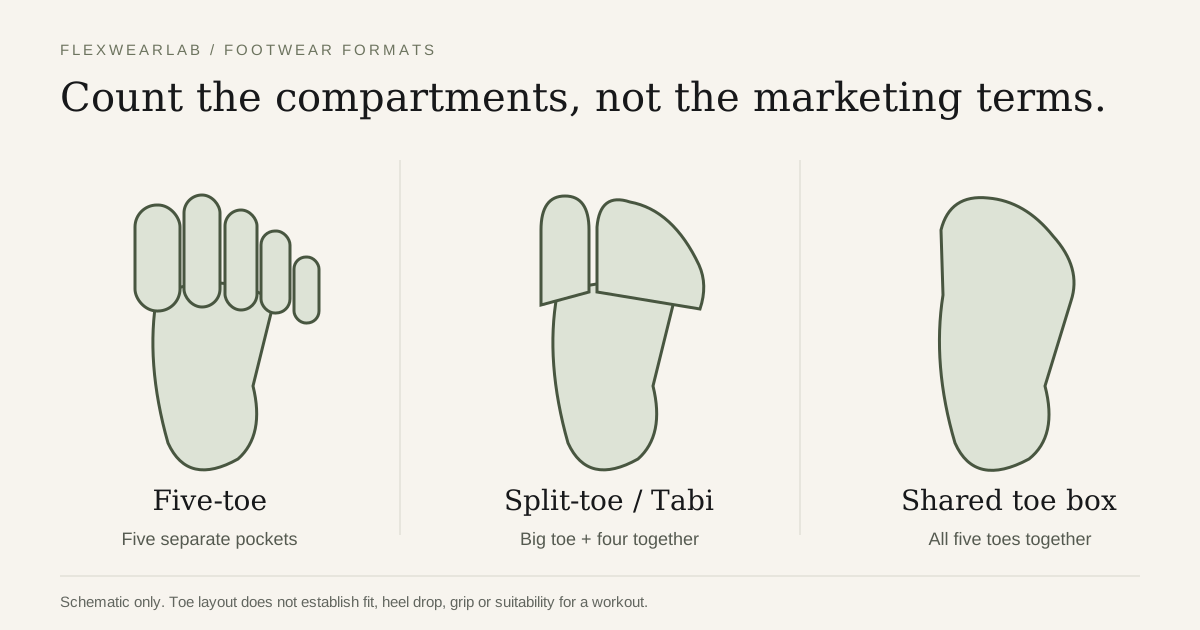
No. Five-toe shoes separate all five toes, while split-toe Tabi separate the big toe from the other four. A fashion split-toe shoe should not inherit gym suitability from its appearance.
How should I clean them after gym use?
Follow the model's care instructions. Vibram's FAQ gives cold, gentle washing and air drying as its general guidance and says not to use a dryer. Leave enough drying time before the next planned use rather than relying on heat.
Does a men's and women's EU size fit identically?
No. Vibram says the men's version of the same EU number is slightly longer and wider than the women's. Check the chart attached to the actual listing instead of treating matching numbers as interchangeable.
Products mentioned
Research shortlist, presented without ranking. Check the linked product details or current listings for available variants and sellers.
Vibram Men's FiveFingers V-Train 2.0 — Black/Black, EU 45
Manufacturer information · not testedThe gym-focused model with lateral TPU panels, laces and a hook-and-loop closure. The link selects men’s EU 45 / US 11–11.5; choose your own size. The checked offer was from third-party retailer Grivet Outdoors.
Pros
- + Separate lace and strap adjustments
- + Regional manufacturer specifications describe arch rope lugs
Cons
- - Not protective lifting footwear
- - No measured grip or stability advantage established here
Vibram Women's FiveFingers KSO EVO — Black/White, EU 38
Manufacturer information · not testedA simple adjustable-upper option. This link selects women’s EU 38 / US 7.5–8 as an example, not a sizing recommendation. Select your measured size and confirm the seller; the checked offer was from third-party retailer Grivet Outdoors.
Pros
- + Individual toe pockets
- + Manufacturer positions this model for functional and strength workouts
Cons
- - Every toe pocket must fit comfortably
- - Seller, size availability and return terms can change
Still comparing? Search Amazon
Our storefront →Today's Deals →Quick searches, tagged so you support the site at no extra cost. See this month's deals page for the picks that are discounted right now.
Amazon prices and availability change often; check the listing for current details. As an Amazon Associate I earn from qualifying purchases.


